Introduction
A wisdom tooth growing at an angle can trap food and bacteria under a flap of gum tissue, a condition called pericoronitis, or slowly crowd and damage the molar next to it, and both of those can be well underway before you feel anything. That is why removal is sometimes recommended for a tooth that is not currently hurting. Pain arrives late in this particular sequence, which makes it a poor early warning system, and it is why we assess wisdom teeth on findings rather than symptoms when we discuss extractions.
To be clear about what this article is and is not: whether any specific wisdom tooth should come out is a clinical judgment about that tooth, in that mouth, at that age. There is genuine professional discussion about how aggressively to treat wisdom teeth that are causing no symptoms, and we will say plainly below when we would recommend leaving one alone.
Here is what actually goes wrong quietly, and what we look at when deciding.
The Short Answer
Reasons an impacted wisdom tooth may be recommended for removal despite no pain:
- Pericoronitis risk, where a flap of gum over a partly erupted tooth traps bacteria
- Decay on the wisdom tooth itself, in a spot you cannot reach to clean
- Decay or bone loss on the second molar in front of it, which is the more valuable tooth
- Pressure on the adjacent root, which in some cases causes resorption
- Cyst formation around an unerupted tooth, which is typically painless early
- Recurrent gum inflammation that quietly comes and goes
- Position that will never become cleanable, making the problem a matter of when rather than if
Reasons we might not recommend removal are further down, because they matter just as much.
What "Impacted Wisdom Teeth" Actually Means
Impacted does not simply mean "still under the gum." It describes a tooth that cannot reach a normal, functional position, and the specifics change the risk considerably.
The variables that matter:
- Angulation. A tooth can be angled forward into the molar in front, backward, sideways, or upright. Angled teeth are more likely to cause trouble than upright ones
- Depth. How far below the gum and bone the tooth sits
- Degree of eruption. Fully covered, partly through, or fully erupted
- Available space. Whether the jaw has room for the tooth at all
- Relationship to the tooth in front, meaning whether the wisdom tooth is in contact with it
Our extractions page describes exactly this pattern: an impacted wisdom tooth "growing at an angle instead of straight through the gum line" can cause "pain, uneven emergence, or partial protrusion."
The counterintuitive part is that a fully buried tooth is sometimes lower risk than a partly erupted one, because a fully covered tooth is sealed off, while a partly erupted one has an opening to the mouth that cannot be cleaned.
Why Pain Is a Late Signal
Teeth are not good at reporting slow problems, and this is the single most useful thing to understand about wisdom teeth.
What tends to happen silently:
- Decay begins on a surface you cannot see or reach
- Bone loss develops on the back of the second molar, where a probe finds it long before you feel it
- Root resorption on the neighbouring tooth, which has no early symptoms at all
- Cyst development around the crown of an unerupted tooth, often discovered only on a radiograph
- Low-grade inflammation that you register as occasional tenderness and then forget
By the time there is real pain, one of these has usually progressed. Pericoronitis in particular tends to announce itself as an acute episode of swelling and difficulty opening the jaw, which is a bad week rather than an early warning.
That is the whole argument for looking rather than waiting. Not that every wisdom tooth is a problem, but that the ones which are do not tell you early.
Pericoronitis Risk and the Gum Flap You Cannot Clean
This is the mechanism most people have never had explained, and once it is explained the logic usually lands.
When a wisdom tooth comes partway through, a flap of gum tissue can remain over part of the crown. Our extractions page calls this flap an operculum and notes it makes the tooth "hard to clean and susceptible to infections like pericoronitis."
Why that flap is such a problem:
- It creates a pocket between gum and tooth with an opening to the mouth
- Food and bacteria collect underneath it
- A toothbrush cannot get under it and floss cannot reach it
- Rinsing does not clear a pocket
- Inflammation there tends to recur rather than resolve
- Flare-ups often coincide with being run down, stressed, or unwell
The pericoronitis risk is therefore structural rather than behavioural. It is not a hygiene failure on the patient's part; the anatomy is simply not cleanable. That is why "brush better" is not a treatment plan for a partially erupted third molar, and why the discussion turns to removal.
The Tooth We Are Really Trying to Protect
Here is the point that changes most people's thinking. Often the concern is not the wisdom tooth at all.
The second molar sitting in front of a wisdom tooth is a functional, load-bearing tooth you want for life. When a wisdom tooth angles into it:
- Food and plaque get trapped between the two, in a spot no brush reaches
- Decay can develop on the back surface of the second molar, which is difficult to restore
- Bone can be lost along that back surface, which is difficult to regain
- In some cases the wisdom tooth's pressure causes resorption of the second molar's root
A cavity on the back of a second molar is an awkward, expensive repair, and gum and bone loss in that position is worse. Losing a second molar to protect a wisdom tooth is a poor trade, and this is the calculation that most often tips a recommendation toward removal.
Worth saying plainly: this practice does not offer dental implants, so a tooth lost back there is not simply replaced. Preserving what you have matters correspondingly more.
Why an Asymptomatic Impacted Wisdom Tooth Still Gets Watched
An asymptomatic impacted wisdom tooth is not automatically a candidate for removal, but it is a candidate for monitoring, and the two are different things.
Monitoring in practice means:
- Periodic clinical examination of the area
- Radiographs at appropriate intervals to check the tooth, the bone, and the neighbouring root
- Watching gum condition around any partly erupted tooth
- Noting any change in position or in the bone level behind the second molar
- Asking about episodes you may have dismissed, like brief swelling or a bad taste
Age is part of the picture too. Roots continue developing and bone characteristics change over time, which tends to make removal technically simpler and recovery more straightforward earlier in life than later. That is a general clinical pattern rather than a rule about your mouth, and it is one reason the conversation often happens in the late teens and twenties.
When Wisdom Teeth Removal Is Not Recommended
We want to be as clear about this as about the reasons to remove, because plenty of wisdom teeth are fine and should be left alone.
Situations where we would generally not recommend wisdom teeth removal:
- The tooth is fully erupted and in a normal, upright position
- It has an opposing tooth to bite against and is doing useful work
- You can clean it properly, and the gum around it is healthy
- Radiographs show no decay, no bone loss, and no cyst
- The second molar in front shows no damage
- There is no history of recurrent inflammation in the area
In those circumstances the sensible plan is to keep it, keep cleaning it, and keep an eye on it. Surgery has its own risks and recovery, and there is no reason to accept those for a tooth that is functioning well.
If a dentist recommends removing all four wisdom teeth without examining findings specific to each one, it is entirely reasonable to ask what they saw on the radiograph that supports it. That is a normal question and any dentist should welcome it.
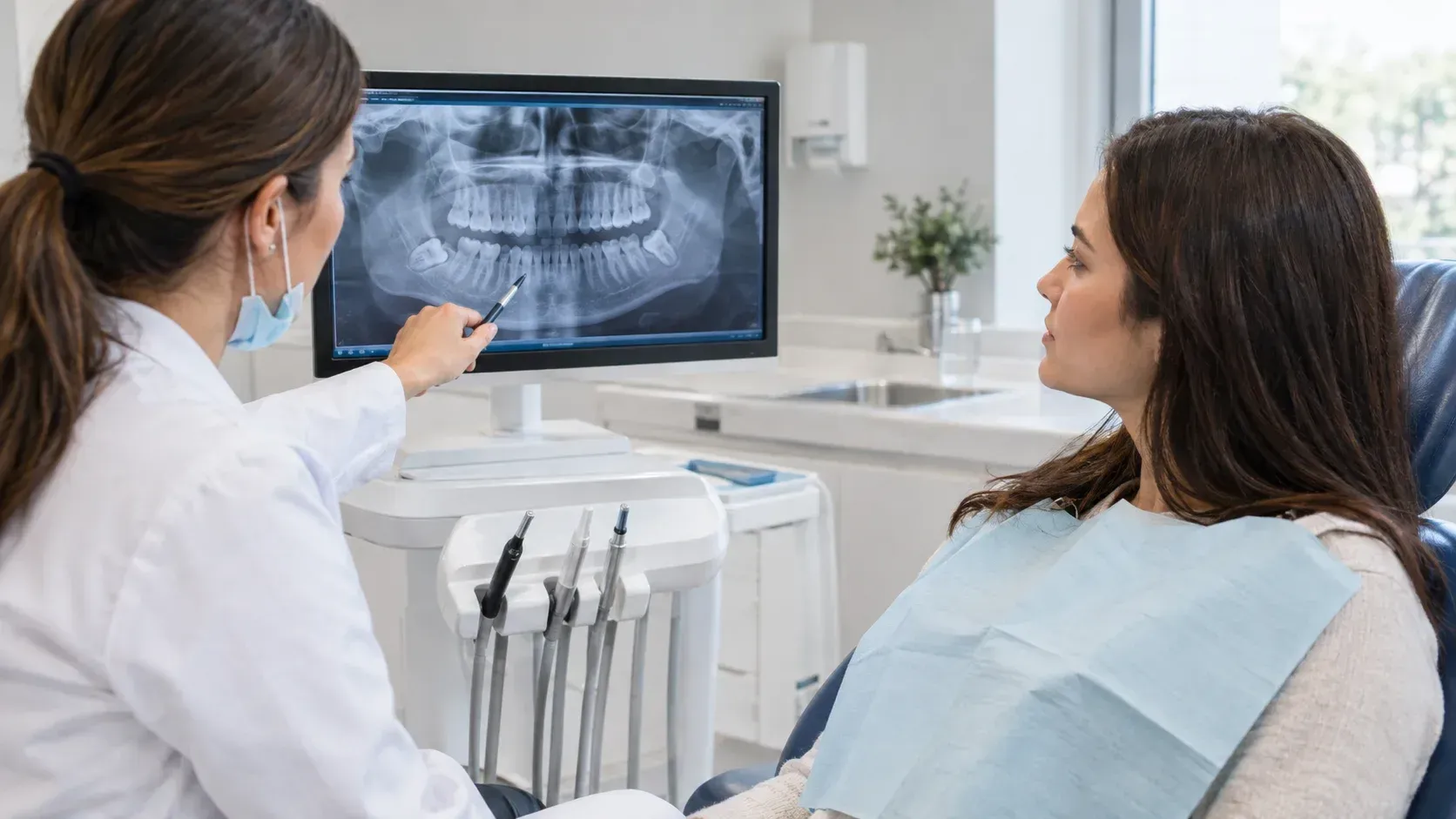
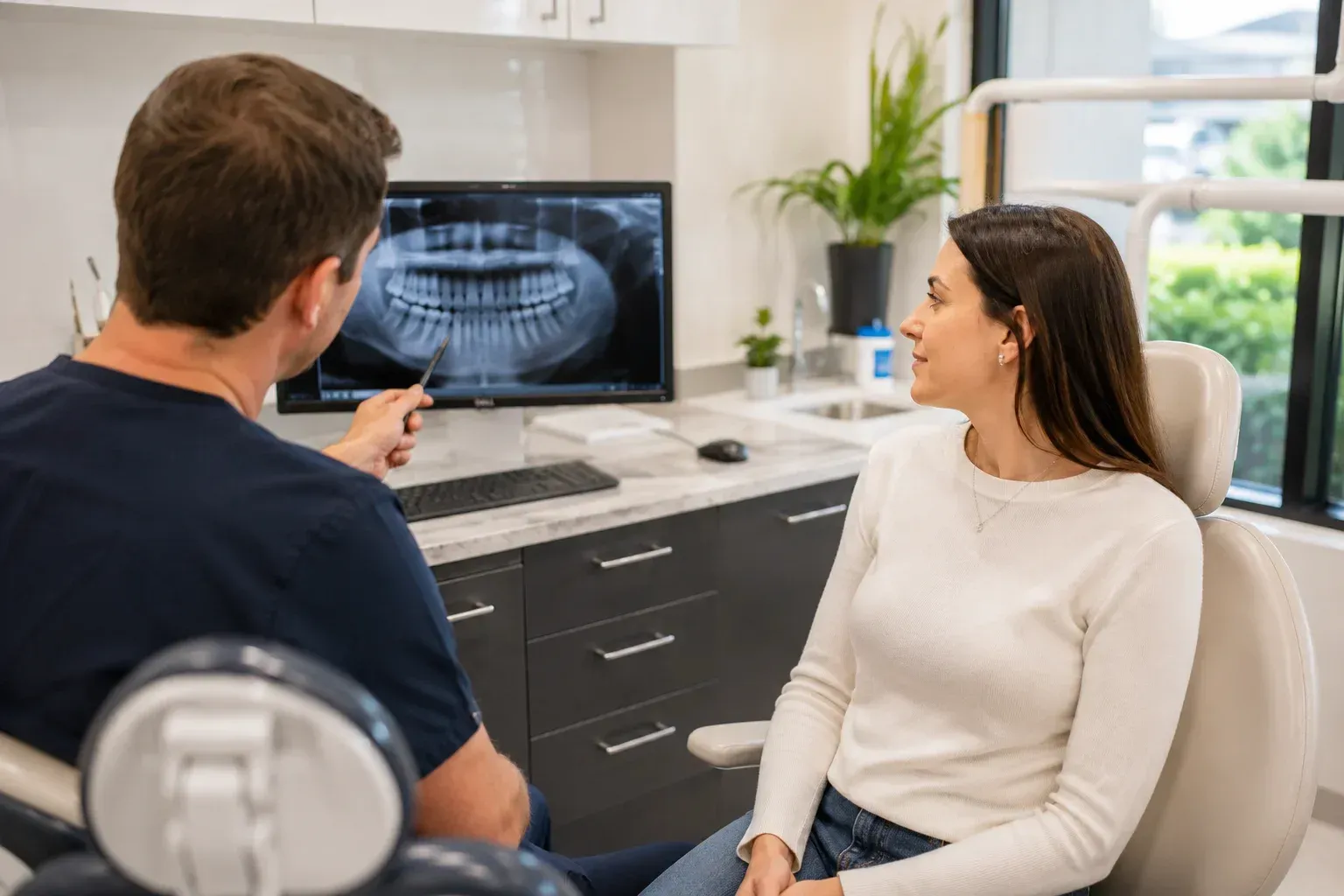
What an Exam and X-ray Actually Show
The reason a recommendation needs imaging is that most of the relevant information is invisible.
An exam and radiograph let us see:
- The angle and depth of each wisdom tooth
- Whether it is in contact with the second molar, and what condition that contact is in
- Bone levels behind the second molar
- Decay on either tooth, including surfaces hidden from view
- Any cyst or unusual radiolucency around an unerupted crown
- Proximity of the roots to the nerve in the lower jaw, and to the sinus in the upper jaw
- Root shape and development, which affects how removal would be approached
That last item matters for planning as much as for deciding. Root proximity to the nerve is exactly the kind of thing that determines how a removal should be handled and what to discuss with you beforehand.
What the Procedure Involves at Our Practice
For anyone weighing this, some plain information about what actually happens.
- We use local or general anaesthesia, based on the doctor's assessment and your preference, to keep the experience comfortable
- Removal involves gently loosening and extracting the tooth, sometimes in pieces if it is tightly impacted
- Recovery guidance includes soft foods, and avoiding straws and smoking, both of which can disturb healing
- Full written aftercare is available on our post-op instructions page, worth reading before your appointment rather than after
- We will tell you what to expect for your specific case, since a shallow upright tooth and a deeply impacted angled one are different procedures
Our FAQs cover several of the questions patients ask before booking, and initial consultations are free if you simply want an opinion.
Conclusion
Impacted wisdom teeth sometimes need to come out before they hurt because the problems they cause, decay in unreachable places, pericoronitis under a flap of gum, and bone loss or damage to the second molar, all develop quietly. Pain is the late chapter of that story, not the opening one.
At the same time, removal is not a default. A well-positioned, cleanable wisdom tooth with healthy gum and clean radiographs is a tooth to keep. The right approach is to have the specific teeth looked at, understand what the imaging shows, and make the decision on findings rather than on either pain or a blanket rule.
Not Sure If Your Wisdom Teeth Are a Silent Problem?
A simple exam and X-ray will tell us. We will look at the angle and depth of each tooth, the condition of the molar in front, and the bone behind it, then tell you plainly whether removal is warranted or whether monitoring is the better plan. Crown Dentistry of the Palm Beaches has served Greenacres, Wellington, West Palm Beach, Royal Palm Beach, Boynton Beach, Century Village, and Boca Raton for over 35 years under Dr. Thomas Saitta and Dr. Freyda B. Cohen. We accept most PPO insurance plans, offer third-party financing, and initial consultations are free. Call 561.964.2002, Monday through Thursday, or contact the practice to arrange a look.